 Skip to main content

 Ian O’Neill
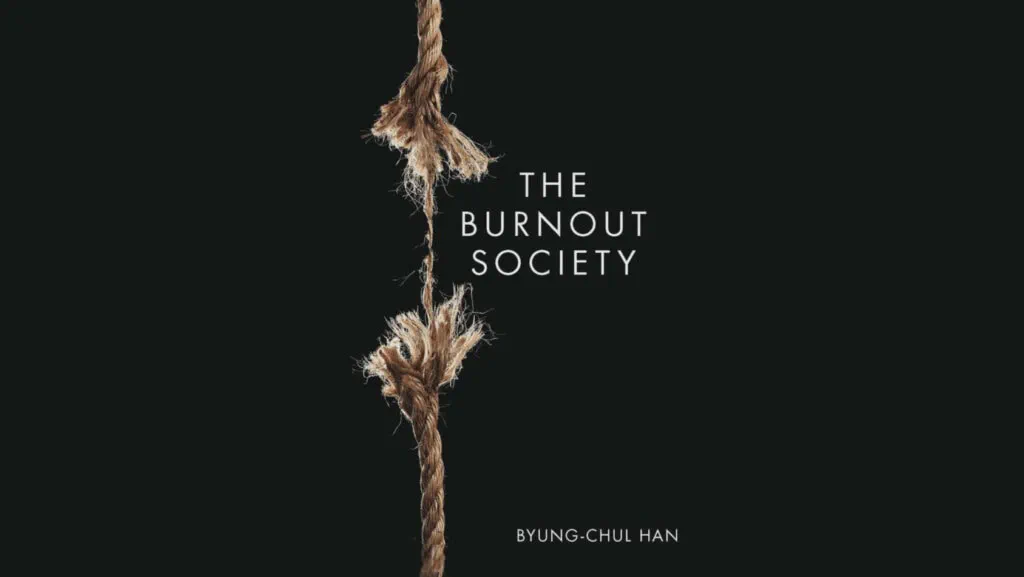
In The Burnout Society, German philosopher Byung-Chul Han draws a connection between contemporary struggles with anxiety, depression and “burnout” to a decades long seismic shift in Western countries that, according to Han, morphed society from traditionally championing “discipline” into a “self-optimization” culture. I suggest this idea may have significant relevance to psychotherapy by making it easier to understand the cultural context of contemporary problems with mood disorders.
Han writes “Today society is no longer Foucault’s1 disciplinary world of hospitals, madhouses, prisons, barracks, and factories. It has long been replaced by another regime, namely a society of fitness studios, office towers, banks, airports, shopping malls, and genetic laboratories. Twenty-first-century society is no longer a disciplinary society, but rather an achievement society. Also, its inhabitants are no longer ‘obedience subjects’ but ‘achievement-subjects’. They are entrepreneurs of themselves.” (The Burnout Society 2015). This struck me immediately as correct.
I suggest that what Han has observed in The Burnout Society is humanity’s “pushback” against the logical implications of the transistor (a most important invention in the 20th century) and it’s implementation since 1958, the year the integrated circuit was invented. The individual empowerment emergent in it’s wake (especially after the Internet came into widespread use) fundamentally alters power relationships, gradually and inevitably. Covert resistance to this shift, not by conspiracy but as a function of human nature I suggest, is the inevitable result. What follows in the present day is freedom by half measure; freedom but not necessarily freedom, something similar to a Shogunate for the world. We pay lip service via participation in a “new economy” we may or may not know is largely a fiction masking real power. Consequently many are now in danger of suffering burnout.
Prior to around 1980, society’s outcasts were generally labeled “abnormal” and separated from the “normal” via institutions such as prisons and mental hospitals, ultimately perhaps because they were unable to take orders or otherwise follow the rules. Today’s outcasts are more likely to be labeled “depressives and losers” according to Han; those unable to live up to demands for self-motivation.
In the contemporary workplace, Han’s “achievement subjects” find themselves in seemingly high-performance cultures governed by “yes” instead of “no”; one must self-sacrifice and live up to the entrepreneurial spirit of “should” and go the extra mile for the team. Unlike Foucault’s “obedience-subject,” who was shaped by disciplinary power and prohibitions, the achievement-subject is ruled by “positive pressure”—goals, productivity, and self-enhancement which paradoxically leads to fatigue, depression, and isolation. If Han is right, society has now co-opted personal initiative and weaponized it against itself. “In this society of compulsion, everyone carries a work camp inside” is a line from The Burnout Society that might become famous.
Han characterizes the twentieth century as an “immunological age” devoted in essence to the task of “distinguishing clearly between inside and outside, friend and foe, self and other”. He draws an analogy to our immune system fighting off bacteria – similarly 20th Century society was a system of resistance to the “other”, hence Han’s reference to immunology. The vocabulary and preoccupations of the last century included “Cold War”, “World War”, “attack” and “defence”, a lexicon that was almost entirely a military dispositive, a “dialectic of negativity” according to Han. Now society is different however, but has war gone away in recent years? Of course not, yet today instead of being predominantly coerced by external forces we are driven internally to perform, achieve, and produce under the illusion of freedom but, I might add, still beholden to war. What appears as autonomy is actually a form of soft domination— which Han calls a “violence of positivity” where the absence of external coercion conceals deeper internalized control.
A Personal Anecdote
When I was very young I was persuaded to join a multi-level marketing scheme which gave me an early taste of this new approach to business life, then in it’s genesis. We were told incessantly that we were “winners” for having joined, because it demonstrated we had a desire to be above the crowd, to not be “9 to 5 work slaves”, instead we were to earn our financial freedom through the multi-level marketing system. We quickly became enmeshed however in a micro culture of manipulation, egoism and impatience. We had monthly sales goals but if we didn’t reach them no one would be there to discipline us, yet missing the goals was acutely painful. We experienced a great deal of self-imposed pressure, after all if we really were winners we would find it in ourselves to work hard, work smart, be persuasive on the basis of our desire for financial success, or else what was the truth about us really? Were we really losers? If we succeeded then all the glory was ours, but if we failed we shamed ourselves, kindling any self-esteem problems that might be lurking. I realize now that this shame was our own emotional weaknesses set against us. We shouldered all of the blame and financial burden for failure, unaware of circumstances beyond our control that set us up. More on that in a minute.
Self-Manipulation
For Han, freedom in contemporary society is illusory because we now prohibit ourselves, exploit ourselves (often sacrificially) in the name of self-improvement, achievement and freedom. In the workplace and the political sphere however these values are not freely chosen, they are co-opted by the profit motive and power dynamics which generally do not lead to personal agency, they invoke self-exploitation. We work extra hours for the same or less pay, even accepting lower living standards than previous decades in some cases. Objecting to these conditions risks job loss, invoking wide spread self-censorship. As achievement subjects everyone must be self-motivated, self-disciplined, and constantly productive, or else we suffer our own private self-punishments, or worse.
Back in the day, as multi-level marketers my friends and I believed we were earning our financial freedom by going the extra mile, working after work to recruit and sell for a system that promised personal power and the joy of financial independence. Not. Not at all. Much to our chagrin, the exact opposite was in fact the reality of our lives. We had become pawns in a Ponzi scheme that used our frustrations and emotional weaknesses to exploit us. I can remember my beautiful first wife on her knees sobbing and screaming in absolute frustration because for the tenth week in a row our bank account was not balancing, we would have to add our own money (which was hard earned in our 9 to 5 jobs) to pay the bill our “business” had de-facto racked up for us again that week, because other people we had recruited into the business (with much effort on our part) had not been able to sell and recruit enough to meet their obligations for the week, but we felt a moral obligation to make up with our own money what they owed to us, so to keep us in good standing with the system that needed our payment so we could fight another day, otherwise we would fail-out of the system, bringing even more self-imposed shame and frustration upon ourselves. The quest for “financial freedom” had become a moral prison for us that was locked from the inside; we were making ourselves feel guilty for “underachieving”, largely unaware this was a circumstance not entirely of our own making.
Hyperindividualism
What Han calls “Hyperindividualism” obscures structural power; we are blind to the collective and structural realities that are in essence social and political, not only personal failings and problems. Moreover, this fragmentation of experience undermines solidarity and resistance; today many jobs pay less in real terms than they did ten years ago. So when jobs pay less and demand more, Han would say we’re seeing the achievement society’s fault lines exposed. Unfair economics now translates into a regime of positivity and self‑optimization, running its victims ragged – hence burnout.
Walking Away
One day, in the early summer of 1985, I sat down with a very senior member of the multi-level marketing company’s sales force, and he asked me a question: “Ian, how much do you think I make in the business?” My friends and I thought we had been told that such ranking members made six figures annually, which was an enormous sum in those days. They could sit at home not working and earn six figures, so this is what we all wanted. “Twenty thousand dollars” he said. “Ian get out of the business”. In that moment an enormous weight slid off my shoulders. Walking out into the warm summer sunshine after that meeting I felt enormous relief, one of the greatest of my life. “I am free. I am free. I am finally free!” I said to myself. It had been four long years of trying to make that system work for myself before someone had the courage to tell me the truth.
In my opinion, my experience as a multi-level marketing “pawn” was a microcosm of what tens of millions of people are going through today in the post-modern2 global economy that Han talks about. They may not be in multi-level marketing, but the fragmentation of experience in the present day – through social media especially – renders the problem my friends and I faced in the 80’s much more widespread because burnout, anxiety, or precarity similar to what we experienced are now individualized en masse. (I should add that according to many experts the present-day global economy is also a Ponzi scheme – but that is a subject for another post). My only option in 1985 was to walk away. Walking away from the global economy is a far, far greater challenge, meanwhile we must live and thrive within the economy as presently constituted!
Responsibility
I will add that it is important to understand regardless of the time in which we live it is our individual responsibility to ourselves to achieve and maintain mental wellness, to the extent we are able. I may have failed as a multi-level marketing pawn, but I bear the responsibility of choosing to join that organization, and I bear the responsibility to myself of finding a healthy vision, goals and aspirations for my life regardless of a setback like that. Moreover, any business requires investment, including a multi-level marketing business. We were too inexperienced to fully understand that this was the reality of our situation, and too poor to stand much chance in addressing such a problem. The odds were decidedly against us. That I failed to understand this circumstance at the time is ultimately my responsibility. My personal responsibilities never went away because I invested time and money in a Ponzi scheme. Yes, the system was corrupt, and yes I was victimized, but that did not take away my responsibilities to myself.
It is also important to understand that serendipity played a role; the “leaders” of the multi-level Ponzi scheme got in first, I wasn’t introduced to it for another three years, by that time the eighties had begun with it’s nascent achievement culture and there were thousands of us “Ponzi pawns” out there all chasing the same pie, with ever diminishing results. As a side note, in his book Fooled by Randomness, writer Nassim Taleb asserts it is inherent to the human condition to frequently succumb to over confidence in one’s skill or the data one has on a given topic, especially when one wants something to be true. However, he reminds us that probabilistic thinking, skepticism, and resilience are crucial to successful living, and that this often takes a back seat to wishful thinking. That was certainly my problem when I was a multi level marketer! Moreover, in life, especially in the workplace, we only see the winners, assume they were skillful whilst failing to understand that many others did the same thing and failed. (In fact randomness according to Taleb is far more responsible for the success of many than anyone truly realizes. This is a fact as sobering as realizing we are responsible for our own actions – I will have more to say on this in a future post.)
Hyperattention
To add insult to injury, while under the sway of multi-level marketing, my friends and I were blind to the real opportunities in our lives. At that time a university education was still affordable, and carried more weight, at least if you got a career related degree. Many of my friends didn’t obtain a post-secondary education, believing it to be a distraction from their pursuit of financial freedom. Byun-Chul Han calls this kind of delusionary thinking “hyperattention”, namely the act of focusing strictly on what the self-optimization culture wants people to concentrate on. According to Han, hyperattention is a structural change of wakefulness in the present day – we’re being systematically manipulated to think acting in our self-interest is about pursuing the goals of the financial system. That sounded very familiar to me!
The “Vita Contemplativa” vs “Vita Activa”
The mid-century phrase “there is never enough time in the day” has only become more relevant today. We are busy, albeit often without any thought whatsoever of the sublime. We strive to make the grade financially in the work-a-day responsibility we have – for one more day – then we do it all over again tomorrow. On this treadmill we have forgotten the “Vita Cotemplativa” (meaning “the contemplative life”, also the title of another book by Han), the classical notion of the sublime, the awareness that beauty and perfection transcend and are immortal. Instead we subscribe by default to the “Vita Activa” (the active life) otherwise known as the colloquial “daily grind”. Furthermore, counter to Hannah Arendt’s 20th century fear that workers were being reduced to beasts of burden, Han suggests present day workers “are equipped with an ego just short of bursting…(and) is anything but animalian. It is hyperactive and hyperneurotic. There must be another answer to why all human activities in late modernity are sinking to the level of mere laboring – and, more still, why such hectic nervousness prevails.” This musing appears to be a central motivation for writing The Burnout Society. Just a few paragraphs later, on page 19, Han makes the “everyone carries a work camp inside” suggestion. The “other answer”, I suggest is human nature itself—namely an evolutionary need to avoid knowing the truth except by increments, but that must be the topic of a separate article also.
Tiredness
There is also Han’s important comparison of that coveted go-to skill in the current world of work—multi-tasking—to the activities of wild animals. Han argues multi-tasking is a regression that mimics a vigilant wild animal, looking here and there for predators i.e. problems with the potential to threaten existence, or at least wellbeing animals of course are unaware of Vita Contemplativa. Similarly Han suggests we are tired in the wrong way; we suffer from the tiredness of “I” instead of the tiredness of “we”. “I” is the solitary way of being tired, in contrast to the “reconciliatory” tiredness of we. We tiredness is the exhaustion felt after inspired work, likely shared with others and fostering connectivity; an example of “we” tired I can think of is “all of us were so tired at the end of the church food drive, but it was worth it” verses a “I” tired, which is the tiredness we feel when we are self-critical in the wake of a personal failure to meet expectations of the achievement society e.g. “my performance review was less than stellar”.
The Relevance of Psychotherapy
How is all this relevant to psychotherapy? It might be obvious to you already. Many of the clients I have seen in the past ten years suffer from any one or all of fatigue, anxiety, depression and burnout. If the 21st century is about anything at all, it will be about finding a much greater understanding of how nature achieves optimal balance and why that balance is important. Psychotherapy is essentially about helping the client define the healthy emotional balance that answers their dilemma. Byung-Chul Han writes about a systemic imbalance of power that each of us must learn to cope with effectively lest we slip into anxiety and depression – in other words, the world of work today may be making us emotionally sick. Compromises to physical health are a possible outcome, important relationships can also dissolve and it may even lead to job loss if the vagaries of the workplace become overwhelming. I believe these circumstances might explain in part why mental health is such a popular topic today and highlights the necessity of safe-guarding one’s mental health. There is therefore a direct relationship to psychotherapy!
In Summary: 5 Reasons to Read the Burnout Society
The endemic “burnout” crisis indicates society is in the midst of a crisis of freedom lost and freedom misunderstood. I said earlier that the 21st century is fundamentally about reconceptualizing balance; the burnout Han writes about tells us global society currently lacks appropriate balance, and remains a catalyst for change. For Byung-Chul Han late modern freedom is illusory because the modern subject believes they are free while compulsively self-optimizing, self-monitoring, and self-exploiting; they live a “violence of positivity” while perhaps totally ignoring vita contempliva. This can’t be good, to which I will add exercising personal responsibility has always been, and will continue to be the challenge. Recognizing “burnout” if and when we experience it and coming up with our own personal solutions based in part on the context Byung Chul Han’s book offers may be very helpful in the coming months and years.
And finally here are my 5 reasons to read “The Burnout Society”:
1. / You may recognize yourself in the pages – it’s important to know you are not alone.
2. / The book shows you how being “burned out” is not your fault.
3. / The book reminds you of the importance of stopping to smell the flowers – to embrace the “contemplative life” more often.
4. / “The Burnout Society” teaches you the difference between healthy tiredness and being burned out and how to recognize the difference in yourself.
5. / It may be an important step in finding the motivation to reset your priorities in life.
6. / One bonus reason: it’s a short book!
And one disclaimer: this is a philosophy book, not a self-help book! It’s about putting your life into greater context.
1Michel Foucault introduced the idea of the disciplinary society in his 1975 book Discipline and Punish: The Birth of the Prison (Surveiller et punir: Naissance de la prison in French).
In this work, Foucault traces the historical shift from sovereign power—exercised through public punishment and spectacle—to disciplinary power, which operates through surveillance, normalization, and the internalization of control. His analysis of the Panopticon (Jeremy Bentham’s prison design) becomes a key metaphor for how modern societies regulate behaviour through institutions such as schools, hospitals, the military, and workplaces.
2 I prefer to call our current era “late post-modern” – more on that in another post now in the works.